
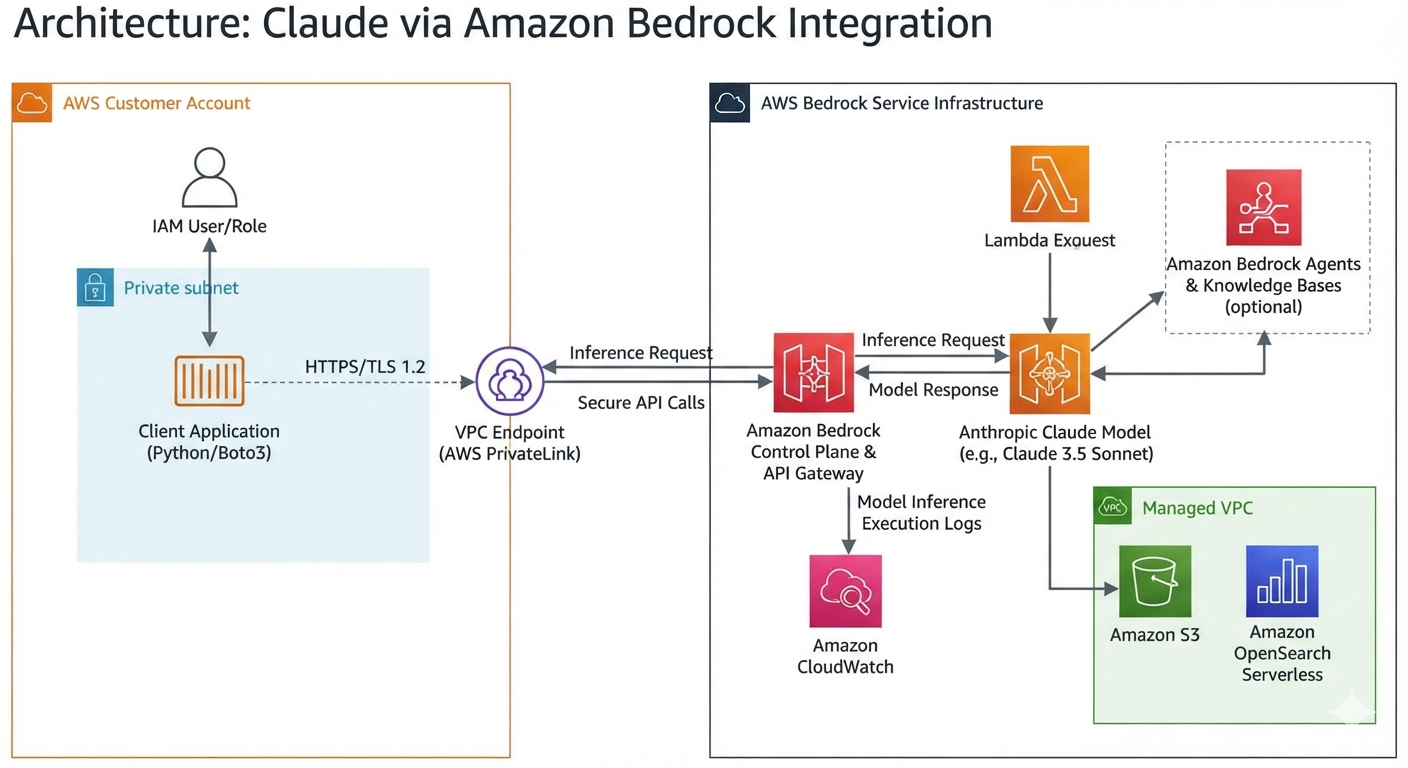
Amazon Bedrock provides a secure, serverless way to deploy Anthropic’s Claude models without managing underlying infrastructure. This technical guide outlines the architectural flow, security considerations, and line-by-line code implementation required for a production-ready deployment.
Architectural Design
[ Client Application ]
       | (IAM Authenticated / HTTPS)
       v
[ Amazon Bedrock Endpoint ]
       | (VPC Endpoint / PrivateLink)
       v
[ Claude Model (Anthropic) ] ----> [ AWS CloudWatch Logs ] (Audit / Metrics)
Key Architecture Components
- Serverless Execution: No infrastructure provisioning or GPU management required.
- Network Security: Traffic stays within the AWS backbone using AWS PrivateLink (VPC Endpoints).
- Data Privacy: Inputs and outputs are encrypted at rest (AWS KMS) and in transit (TLS 1.2+). Your data is never used to train base models.
- Identity and Access Management (IAM): Fine-grained, role-based access control rules govern model invocation.
Prerequisites & Setup
Before writing code, ensure the following steps are completed in the AWS Management Console:
- Model Access: Navigate to Amazon Bedrock > Model access and enable access for the desired Claude model (e.g., Claude 3.5 Sonnet).
- IAM Permissions: Grant the executing environment (Lambda, ECS, or EC2) the following minimal IAM policy:
{
    "Version": "2012-10-17",
    "Statement": [
        {
            "Sid": "BedrockInvocation",
            "Effect": "Allow",
            "Action": [
                "bedrock:InvokeModel",
                "bedrock:InvokeModelWithResponseStream"
            ],
            "Resource": "arn:aws:bedrock:*::foundation-model/anthropic.claude-3-5-sonnet-*"
        }
    ]
}
Code Implementation (Python / Boto3)
This implementation uses the Anthropic Messages API format natively supported by Amazon Bedrock.
import boto3
import json
from botocore.exceptions import ClientError

def generate_architectural_review(prompt_text):
    # Initialize the Bedrock runtime client in a specific region
    bedrock_runtime = boto3.client(service_name="bedrock-runtime", region_name="us-east-1")

    # Specify the target model ID (Claude 3.5 Sonnet)
    model_id = "anthropic.claude-3-5-sonnet-20240620-v1:0"

    # Construct the standardized Messages API payload
    body = json.dumps({
        "anthropic_version": "bedrock-2023-05-31",
        "max_tokens": 1000,
        "temperature": 0.2,
        "messages": [
            {
                "role": "user",
                "content": [
                    {
                        "type": "text",
                        "text": prompt_text
                    }
                ]
            }
        ]
    })

    try:
        # Synchronously invoke the model via HTTPS POST
        response = bedrock_runtime.invoke_model(
            body=body,
            modelId=model_id,
            accept="application/json",
            contentType="application/json"
        )

        # Parse the streaming response body
        response_body = json.loads(response.get("body").read())

        # Extract and return the generated text content
        return response_body["content"][0]["text"]

    except ClientError as e:
        print(f"AWS Error: {e.response['Error']['Message']}")
        raise e

# Example Execution
if __name__ == "__main__":
    prompt = "Review this architecture: Web UI -> Lambda -> DynamoDB. List 3 failure modes."
    print(generate_architectural_review(prompt))
Line-by-Line Code Breakdown
boto3.client(service_name=”bedrock-runtime”, …)
Establishes the SDK connection. Note the use of bedrock-runtime instead of bedrock. The runtime client handles data plane operations (invocations), while the base client handles control plane operations (listing models, creating custom models).
model_id = “anthropic.claude-3-5-sonnet-…”
Defines the unique uniform resource name for the foundational model. Ensure this matches the exact model version enabled in your console.
“anthropic_version”: “bedrock-2023-05-31”
A mandatory parameter for Anthropic models on Bedrock indicating the system schema version to process the payload.
“max_tokens”: 1000, “temperature”: 0.2
Hyperparameters optimizing response length and randomness. A lower temperature (0.2) forces deterministic, factual technical analysis.
“messages”: […]
The structured conversation array. Claude expects alternating user and assistant roles containing content blocks.
bedrock_runtime.invoke_model(…)
The execution call. accept and contentType headers must strictly specify JSON format payloads.
response.get(“body”).read()
The raw payload returns a streaming data body (StreamingBody). The .read() method buffers the complete bytes into memory before parsing.
What’s Next?
If you want to expand on this implementation, consider:
- Code for streaming responses (real-time word rendering)
- Integrating system prompts for specialized architectural persona constraints
- Setting up a VPC Endpoint via Terraform for private network routing
Want to build AI-powered applications? Join an AI hackathon on Reskilll and put these skills to work.